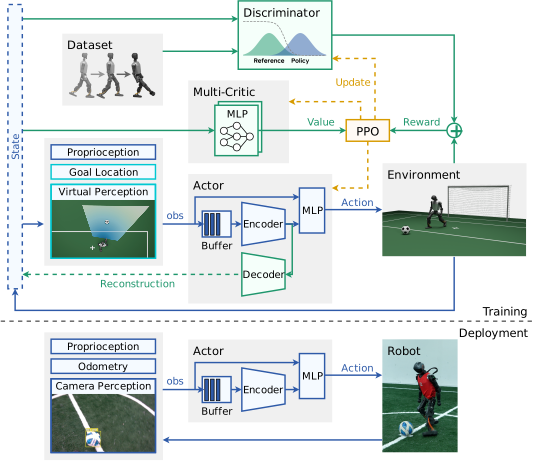
Abstract: Humanoid soccer poses a representative challenge for embodied intelligence, requiring robots to coordinate agile locomotion with unreliable visual perception in dynamic environments. However, existing systems typically rely on modular pipelines that separate perception from control or assume ideal sensing, making it difficult to achieve coherent and reactive behavior under real-world perceptual limitations. In this work, we present a unified reinforcement learning-based controller that enables humanoid robots to learn vision-driven reactive soccer skills by directly coupling visual perception with locomotion control. The robot is trained in simulation to acquire soccer behaviors, and adversarial motion priors guide policy learning toward natural motion patterns. To support robust performance under imperfect sensing, we introduce an encoder-decoder architecture together with a virtual perception system that models key characteristics of onboard vision, exposing the policy to perceptual noise and detection failures during training. This design encourages the policy to internalize perceptual uncertainty and continuously adapt its motion in a closed loop. The resulting controller produces coordinated soccer behaviors using only onboard vision, including ball searching, chasing, and multidirectional kicking. It reduces ball position estimation error by 46% and shortens time-to-kick by up to 64% compared with a rule-based baseline, achieving around 90% kicking success in frontfield positions. Experiments across diverse environments and dynamic scenarios, including real RoboCup competitions, further demonstrate the robust performance of the controller. These results highlight the practical effectiveness of integrating perceptual uncertainty directly into policy learning for achieving reliable vision-driven behaviors in humanoid robots operating under real-world conditions.
We thank Booster Robotics for providing the robot platform, experimental facilities, and technical support. We thank Beijing Beiao Group Corp. Ltd. for providing access to the testing venue. We thank Tinglong Zheng and Yunkang Cheng for assistance in data collection and experiments. This work was partly supported by STI 2030-Major Projects (nos. 2021ZD0201402 and 2021ZD0201401), the Beijing Natural Science Foundation (no. L243004), and the Tsinghua University Initiative Scientific Research Program (Student Academic Research Advancement Program: Zhuiguang Special Project, no. 20257020011).
@article{wang2025learning,
  author = {Yushi Wang and Changsheng Luo and Penghui Chen and Jianran Liu and Weijian Sun and Tong Guo and Kechang Yang and Biao Hu and Yangang Zhang and Mingguo Zhao},
  title = {Learning vision-driven reactive soccer skills for humanoid robots},
  journal = {Science Robotics},
  volume = {11},
  number = {117},
  pages = {eaed1152},
  year = {2026},
  doi = {10.1126/scirobotics.aed1152},
}